A compound with several uses...
Little known to the general public, ammonia, also called « NH3 » is an indispensable tool in many areas, including industry and agriculture.
It is a chemical compound essential for the production of fertilizer, many industrial processes, but also the energy transition. These multiple uses involve ammonia testing with a different objective in each field.
In agriculture, ammonia is the cornerstone of nitrogen fertilizers, feeding crops that fill our plates. In industry, it is involved in the manufacture of polymers, explosives and even pharmaceutical products. Finally, it is also used as a refrigerant, especially in food processing.

In these cases, purity of ammonia is an important criterion to ensure expected production performance.
Ammonia analysis allows to control its composition and optimize its uses. This is essential for its manufacturing, limiting its impacts or exploring new applications, such as its potential hydrogen conversion.
Because ammonia also emerges as a promising energy vector. Capable of storing and transporting hydrogen, it opens up new prospects for a sustainable energy transition. Given the current environmental and energy challenges, why should we pay renewed attention to ammonia and its analysis?
Ammonia content or purity: a key element in many sectors
Depending on the application areas, it may be interesting to validate the purity of ammonia or its presence. As we recall, ammonia is a toxic compound. It causes, among other things, skin and lung irritation and even death at high exposure.

For example, in poultry farms, Timac agro and CMI Roullier pay particular attention to litter. Livestock litter is a mixture of dry organic matter (paille, wood chips, etc.), urine and faeces. This mixture decomposes in the presence of oxygen and produces ammonia (NH3) and nitrous oxide (N2O).
This poses a significant health risk on poultry farms, but also a decrease in the fertilising value of this litter by loss of nitrogen.
Thus, the analysis of ammonia levels emitted by litters through Micro GC Fusion enables them to optimize litter to reduce these emissions.
Interested in this application? Find out more on our collaborative poster with CMI Roullier.
Another case is the need for purity of ammonia or rather the absence of impurities!
Indeed, in many other areas, we want to ensure the purity of ammonia. In processes where ammonia is used as a reagent, the presence of other chemical elements could at best hinder intended uses or even create undesirable by-products.
Today it has a strong interest as a fuel as demonstrated by the CNRS, but also as an energy carrier. Ammonia would be a more economical alternative to the transport of hydrogen from which it is an nitrogen derivative.
Finally, in industrial areas, the absence of impurities is important. The impurities generally sought can be multiple: permanent gases (N2, O2, CH4, CO), hydrocarbons, or traces of reactive compounds used for its production.
MICRO GC & CHEMBOX: advanced tools for ammonia and other gas analysis

Example of 2 chromatograms with CO2, NH3 and H2O at different levels. RT-Q Bond column, temperature programming and single method.
Sensitive ammonia analysis is a challenge identified by Micro GC Fusion.
In fact, ammonia is a compound difficult to sample and analyse. In gas chromatography, it can be difficult to separate from moisture, but not with Micro GC Fusion!
Thanks to the temperature programming, NH3 is easily separated from the water peak (H2O) allowing a quantification of 50 ppm to 100%. Similarly, many other gases can be followed with the same configuration: CH4, CO2, HCN, and others!
One of the advantages of Micro GC is its versatility. It can analyze samples taken from various containers (gas pocket, syringes...), thanks to its integrated pump. This flexibility is valuable for field analysis.
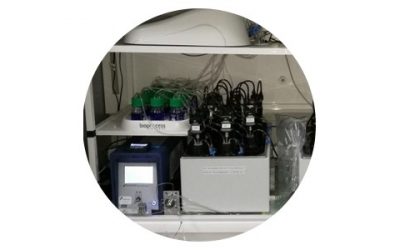
Finally, the Chembox optimizes the monitoring of gas production kinetics. This ensures accurate control of ongoing reactions, particularly to optimize processes.
To go further...
The success of any analytical project depends on choosing the right technology, but also the right sampling.
Chemlys makes the choice of tailor-made accompaniment, guaranteeing your satisfaction.
Interested in examples of ammonia analysis specific to your application (refrigerant, NH3 production, etc.) ?