Why is H2S surveillance important?
The H2S, also known as hydrogen sulphide, is a dangerous gas, easily recognizable by its rotten egg smell. Very flammable and toxic, it forms when organic matter decomposes without oxygen, by the action of certain bacteria or fungi.
The H2S is particularly present in septic tanks, sewage treatment plants or farms: environments conducive to its emission. It is also present in methanization stations.
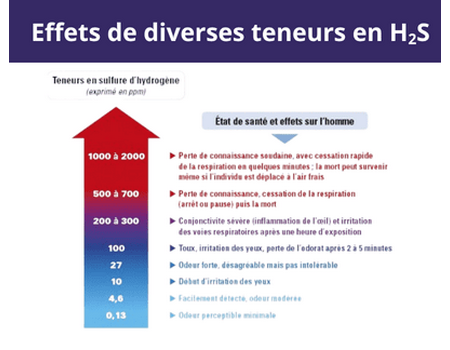
As INRS quotes, the toxicity of H2S is significant from 10 parts per million (ppm). At 100 ppm, it can cause loss of smell. Beyond 300 ppm, it becomes potentially fatal.
Therefore, due to these risks, it becomes essential to monitor its concentration, particularly in hazardous working environments.
Unfortunately, this invisible danger is not theoretical. It is tragically incarnate in very real events...
For example, in 1996, a serious accident occurred in a factory. One employee was fatally exposed to sewage fumes, according to a report quoted by INSPQ.
Therefore, relying solely on the smell is risky. If it is perceptible, it means that the danger is already present. Especially as olfactory nuisances can vary depending on the concentration and adaptation of the smell, making detection even more difficult without a dedicated device.
To better manage olfactory nuisances and ensure the safety of different processes, a gas analyser can be used. This is the case with Micro GC Fusion. This analyser allows rapid monitoring of the gas composition and thus ensures the conformity of production, whether in wastewater treatment, methanization or agri-food.
Why is H2S surveillance important?
The H2S is present all around us: natural gas, crude oil, volcanoes... And even in our body. He can be our friend as our enemy when he is present at high levels.
This is where gas chromatography comes into play.
Analysis of H2S is:
- Whether natural gas is in conformity or simmering a sulphur revolution
- Detect a corrosion onset in a pipe
- Preventing costly breakdowns
- Ensure that a fermentation process does not turn to vinegar (or rather rotten egg)...
In environment, energy, agri-food... The H2S is everywhere. And the proper analysis is not that simple.
The H2S is double-edged: dangerous if you ignore it, but extremely useful if you get to know it. It is valued in various industries, including chemicals and metals. It is therefore important to quantify it properly and analyse it correctly.
Micro GC or GC: the analytical solution for your H2S
To analyse the composition of a gas and in particular to measure compounds such as the H2S, several technologies are available to us. Among the most effective are gas chromatography, whether with a GC or a micro GC. Each has its advantages according to needs, terrain constraints and precision sought.
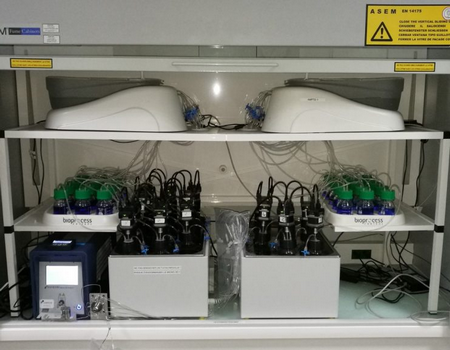
Consider, for example, the SIAAP treatment plant. It produces biogas by methanization. In a logic of upgrading its sewage sludge, it used Micro GC Fusion. This device allowed him to analyse his gases and optimize sludge treatment.
Learn more about SIAAP:
But, the H2S can also be measured at lower levels!
Interest is, for example, in H2S in natural hydrogen. There may be, by the action of bacteria, certain H2S contents, composed of sulphur... It is therefore desirable to measure this.
CHEMLYS offers GC valve solutions for trace H2S analysis in different matrices.
These can, for example, enable rapid natural hydrogen analysis with an automatic sample passer.
To go further...
The success of any analytical project depends on the choice of the right technology, but also the implementation of the right sampling. Chemlys makes the choice of tailor-made accompaniment, guaranteeing your satisfaction.
Interested in using your application-specific H2S scan examples?