All analytical equipment requires maintenance phases. These can be punctual (replacement of wear parts) or recurrent (calibration, drift correction, etc.).
These recurrent maintenance phases should be the least frequent and the least time possible to ensure the highest rate of analyser availability. Indeed, in the context of quality control, such as production, the production system can be shut down in the absence of analysis.
The case of microchromatography
In the case of microchromatography, recurrent operations are calibration and regeneration. Calibration can be done on a monthly basis, see annual and mobilises only a small amount of analyser. Regeneration is necessary when analytical performance deteriorates due to column pollution.
Column pollution by unanticipated compounds decreases its separative capacities.
Column regeneration in MicroGC: why, when and how?
Some columns are more sensitive to this phenomenon. This is particularly the case with Molecular Tami (Molsieve 5A) which strongly retains CO2 and water.
This column allows the separation of permanent gases such as hydrogen, oxygen, nitrogen and methane. However, in the presence of CO2, it rapidly loses its separative capacities. It must then be regenerated, i.e. cleaned by heating it to its maximum, which takes 24 hours to 48 hours in isothermal Micro GC.
The contribution of programming
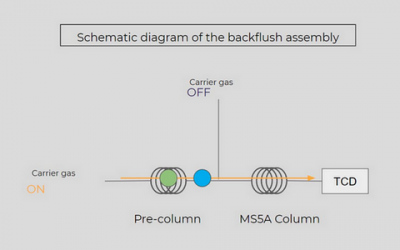
Generally, "sensitive" columns like the Molecular Tami are equipped with a backflush. This precolumn system makes it possible to send to the analytical column that the compounds which it must separate.
However, in high CO2 applications, backflush may not be sufficient to prevent CO2 from passing. This requires compromises.
Temperature programming allows a temperature ramp to be applied and thus protects the column from the introduction of pollutants. It also helps to remove pollutants such as moisture, which could have infiltrated.

Chromatogram of a good separation of CO2 interest compounds at low temperature.

Chromatogram of poor separation of CO2 interest compounds at high temperature.
This allows us to see the second advantage of temperature programming: stability.
« Test sensitivity and stability »
By applying a temperature ramp at the end of the analysis, the columns elect all potential pollutants for each analysis. The analyser remains stable much longer! This is illustrated in the following application note: The stability of the measurement on molecular Tamis (MS5A).
Beyond the stability of Micro GC Fusion ® and the temperature programming technology in °C/second, the regeneration step is now reduced to a maximum of 2 hours! An undeniable asset to quickly restart its installation.
The Micro GC Fusion ® is thus as suitable for industry as it is for research. Its performance is waiting more than your application!